 I happened to recently listen to Freakonomics episode 400 ("How to Hate Taxes a Little Bit Less") and it fascinated me.
Particularly in countries like India, where civic services are extremely poor, a tax payer feels like his or her taxes are being funnelled into a big black hole. The way it currently works is that you pay your taxes, and some opaque process involving central government bureaucrats, parliament, state government bureaucrats, state legislatures, city governments, councils, etc., attempts to funnel that money back into the hands of the local ward official. Remember, that same ward official's office is just around the corner from me, and he/she is responsible for fixing the potholes, keeping the streelights on, picking up garbage, maintaining my neighbourhood public park, etc. He feels no sense of responsibility or accountability to me, the tax paying resident of the ward, but rather to those who allocate his budget in city hall and above. What if, instead, I could allocate a portion of my local taxes (say 50% of my property tax for example), to a specific set of heads? What if each department of the local ward office got 50% of their budget centrally and the balance from what citizens allocated to them? Then they'd have to show concrete results in our neighbourhoods. They'd have to hold community meetings in the community to explain what their plans are for next year and what they did with the money last year. They'd have to actually show results, because we'd move our money to the department that made the best use of the money we gave them. To avoid their spending a ton of money on publicizing their achievements, we'd restrict their marketing budget (perhaps just 5% of the total budget). Radical idea, isn't it? I'd love to hear reasons why it might not work, so that I can refine this model.
1 Comment
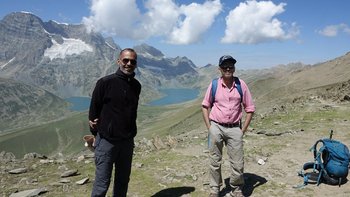 Many years ago, Gautam Gode asked me if I'd be interested in joining him on the Kashmir Great Lakes trek (often referred to as "KGL"). I immediately said Yes! A group was formed, and plans were drawn up in earnest. I even seem to recall having booked flight tickets. Unfortunately, it wasn't to be. Our guide's parents won the Haj lottery, and he had to escort them to Mecca. We didn't want to take a chance with another guide, and so we scrapped our plans. In May 2018, back in hot humid Chennai after having just completed a trek to Rupin Pass, I was itching to get back to the cool bracing air of the mountains. I pinged Gode: "Any treks that you're dying to do?". "KGL" came the prompt answer. "Let's do it in August end, by then the rains would've come and gone." A few quick internet searches later, and we were booked with Bikat Adventures, from 25th Aug to 1st Sept. As the date approached, work exigencies kept hovering over our heads like dark clouds that threaten to rain. However, this time our luck was right, and we managed to get off work, and do the trek we'd been dreaming about for a while. 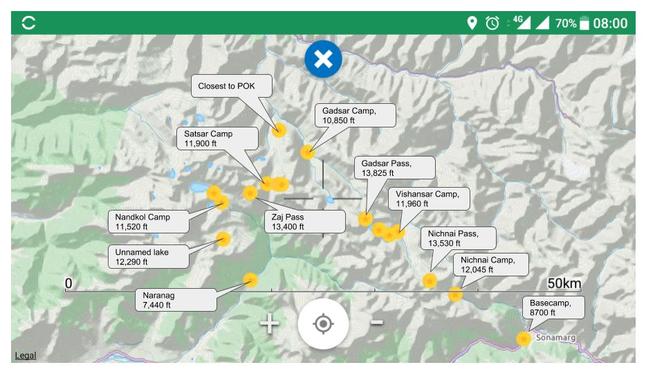 The Route KGL generally starts at Sonamarg (8,700 ft), winds its way through Vishansar, Kishansar, Gadsar, Satsar, Gangbal and Nandkol lakes, ending up at Naranag (7,400 ft). It takes 6 days, including a buffer day for bad weather. 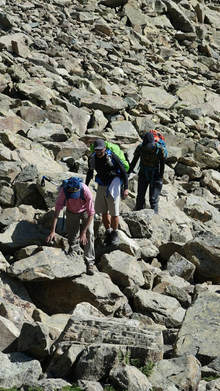 There's a lot of climbing and descending (approx 3,000 ft each day), and lots of rocky moraines to cross along the way. You reach a point where you feet scream in protest at the sight of rocks... you just yearn for soft grass to walk on. Walking on rocks takes a special kind of foolhardiness. It is a bit like skiing - when you lose your fear of falling, is when the risk of falling goes away. Our fellow trekkers Gode I thought knew well, but you don't really know someone till you share a tent with them without having had a bath for 6 days. He was the perfect companion, quiet, reserved, not letting on that I stank. It was only towards the end of the trek that I revealed that I had an impaired sense of smell, a consequence of sinus surgery a few years ago. The poor man. 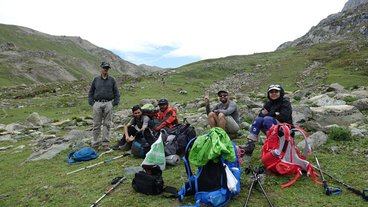 Chetna and Jignesh were Mumbai-born-and-raised Gujaratis who now live outside Manchester. We bonded immediately on shared hiking experiences in the Peak District. Unfortunately, they had chosen to come to KGL straight off their international flight, and therefore jet-lag, food, and water all combined to give them a tough time. The rocky moraines didn't help either, since they were used to walking across the gentle rolling grassy hills of England. Bikat staff tried really hard to accommodate their dietary preferences (dinner at 4:30 pm!) and I think they began to enjoy the trek towards the end. We really lucked out - Bikat's groups are small anyway (not more than 15), but it was just the 4 of us this time! I'm really thankful Bikat didn't make some excuse and cancel the trek, but I'm sure they made a loss on this one. The small group allowed me to experience the benefits of such a size first hand. As opposed to the larger 20-25 person groups of an India Hikes or TTH. There are advantages, for sure. Most days, we left camp last (45-60 minutes after the last group), but reached the next campsite first. 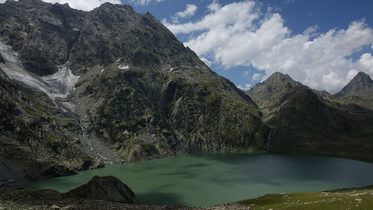 The Lakes Towards the end, in his usual dry style, Gode said: "you've seen one, you've seen them all." But somehow I felt each one had its own magic. Vishansar was the first lake we came upon, and so it was special. Gadsar, which is featured to the left, is really pretty. Satsar is seven little lakes, but the setting is spectacular, since you get your last look at POK from there. Finally Gangbal and Nandkol, the "money shot" at the top of this post, is what everything thinks about when they hear the word "KGL". Most afternoons were free, and some days there were little side excursions we could take. I grabbed every such opportunity, and got to see a few lakes that few other KGL trekkers get to see. If you ever do KGL, I strongly recommend it. There are two lakes above Satsar camp, and two lakes above Nandkol and Gangbal respectively (you can't do both, but do at least one). The guides (lazy buggers) will tell you it takes a long time, but no, it doesn't. I was there and back in 3 hours. 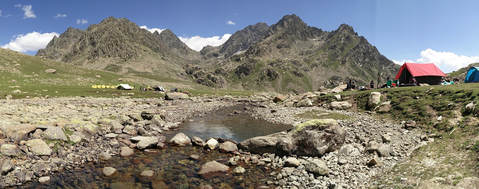 Other trekkers and their trek organizers We had groups from Indiahikes (IH) and Trek The Himalayas (TTH) with us, and I got a chance to compare Bikat, our organizer, IH and TTH. Both IH and TTH groups are much larger, but the TTH groups were loud (playing music past 10 pm) and didn't have the environmental consciousness that IH is known to be obsessive about. TTH's campsites were filthy. That's one organization I'm definitely not going with anytime soon. Bikat's small groups are a big advantage, but I wish they were as environmentally sensitive as IH is. The trekkers from those organizations were interesting. A lot of them seem to have offloaded their backpacks, and yet were struggling. Young people, maybe 25-30 years old, were puffing and panting, walking slowly, or gave up and rode a mule. Arjun Mazumdar, founder of IH, has commented on this -- people's tendency to ignore the physical requirements spelled out before they start a trek. Is there a solution? Besides subjecting them to a fitness test on day 1? I'm not sure if that'll work. 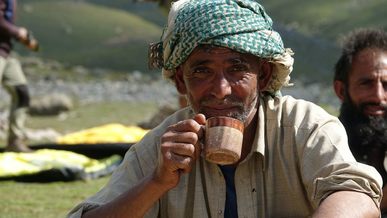 The people of Kashmir I think the one thing that I enjoyed the most was interacting with the locals. From this sheep shearer, taking a tea break from the tiring job of shearing his sheep, to these two small boys who were helping an elder relative tend a herd of goats, everyone we met was almost uniformly friendly and welcoming. A "Salaam Aleykum" almost always got you a "Waleykum Salaam" and then a conversation would ensue. "Where are you from?" "Where did you come from today?" "How do you like our land?". The people of Kashmir, like hill people everywhere, are tough but warm, simple and welcoming. 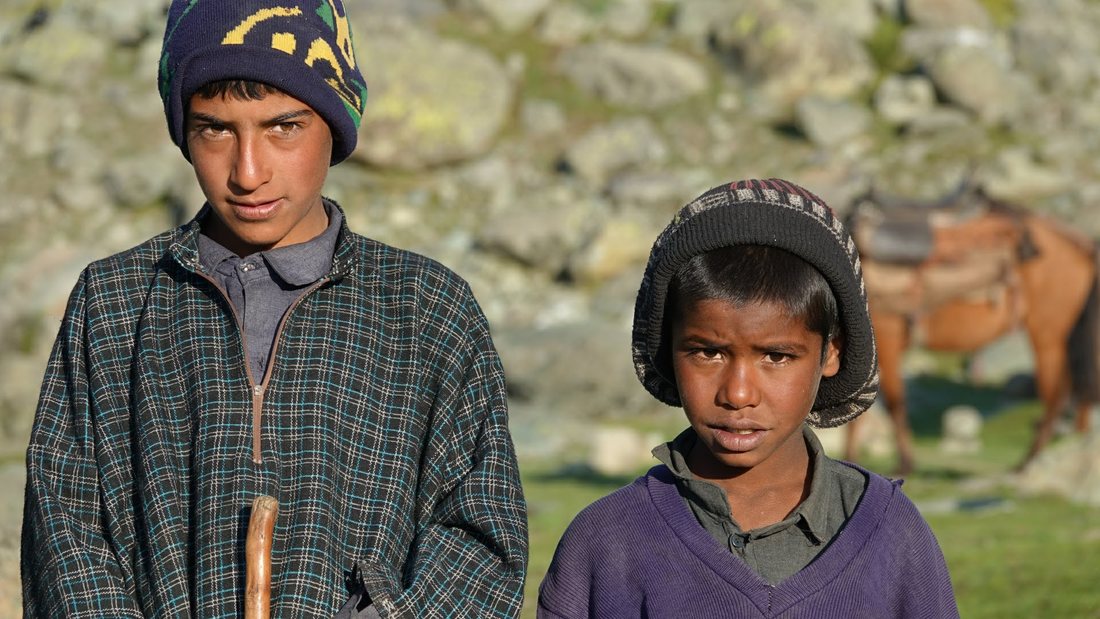 Was I ever concerned about my safety? Never. Ever. The presence of Rashtriya Rifles posts at three points of the trek were a grim reminder that we're in a place where an AFSPA is needed, and our Army, which should be guarding the border, is employed in internal security duties. But the Army-men we met were also warm and friendly, and gave us no concerns at all. I must say that I didn't sense the same warmth for them from the locals, but that's just a gut feeling.
On balance, KGL is a great trek. Accessible, tough but not too tough, and remote enough that spectacular views are almost guaranteed, if you time your season right. 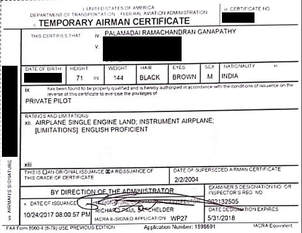 After three weeks of intense training, I had my instrument rating checkride with Richard Batchelder, FAA Designated Pilot Examiner, at his office in Concord, CA. Incidentally “Rich” was my examiner for my Private license in 1999. Oral: We were supposed to meet at 1300h at his office in KCCR. I arrived by 1130 and checked in with him. He was happy that I was on time. I had lunch and refreshed the latest weather. I was back in his office promptly at 1300h. He was impressed that paperwork was well organized – I had a clear sleeve folder with all documents neatly laid out. Had a print out of all XC (with distance covered and distance of furthest airport) and all Instrument flights, so it was easy for him. Wants to see all the A/C information (date of last annual, inspections, etc.) in one place / table (I didn’t do this). Make sure you’ve pulled the codes for areas where you got answers wrong on your written – it makes it easier for him. Plunged straight into the oral – wanted me to sketch the Pitot-static (I forgot to draw the encoding altimeter) and Vacuum systems, list the equipment required for IFR flight (GRABCARDD), the mandatory reporting under IFR (MARVELOUSVFR500). Wanted me to list the total distance, time and fuel consumed for my flight plan. Verified that the numbers were close to what he got when he put it in. We then went section by section of the ACS, with him asking me questions and sometimes putting scenarios in place. Some questions I recall are:
In summary, he went methodically through every section of the ACS and asked a few questions about each area – if he saw you were confident and answered correctly, he moved on. We finished by 1530h. Flight: He then gave me my faux clearance – “Cleared to KSAC via KANAN4 departure, SAC transition, climb and maintain 3,500, departure frequency 119.9 and Squawk 1200.” He told me we’d do the ILS02 into KSAC, hold at SAC, then do the VOR-A into O88, circle to touch-and-go. He didn’t tell me (but I expected it) that the VOR approach would be partial panel. Then some unusual attitude recover in that area, and then back to KCCR for the GPS RNAV 19R approach. Simple enough, airports and approaches that I had flown to many times. I took a few minutes to assemble my charts, study the approaches on last time, and then walked out to the aircraft. He asked me to wait for him to do the pre-flight, so I used that time to turn on the master and save the flight plan into the GPS. He watched me do the pre-flight – I was careful to explicitly call out whatever I was doing. We then strapped in, he gave me some instructions on positive exchange of controls, traffic avoidance, etc. We then taxied out and took off, he was very relaxed and made me feel relaxed. He let me contact the Travis controller and request the approach, at some point he himself cleared me down from 3,000ft (he had amended the altitude) to 2,000 and I flew the ILS well, needles centered all the way to the DH. I even remembered to switch guidance from GPS to VLOC and to identify the VORs and Localizer. As we intercepted the glideslope, I lowered full flaps like I’d been taught, and he started taunting me “full-flaps, is that the way they taught you? That’s really odd.” And so on. I realized he was trying to distract me, and I firmly but politely told him “Yes, that’s the way I’ve been taught, we can discuss it later, I’d like us to maintain a sterile cockpit now.” He stopped then. On reaching the DH, he said “okay, execute the missed”, I did everything correctly, then we switched frequencies back to the controller. He spoke to the controller and asked for a hold at SAC, which was great because it gave me time to get set up. I switched the CDI guidance back from VLOC to GPS, and the GPS took me to the VOR and also told me which way to turn for the hold. I timed the turns and also the tracking really well, because after we reached the holding fix he said “okay, that’s enough, are you ready for the approach?” I was, so off we went to Rio Vista to shoot the VOR-A approach. I switched the inputs again from GPS to VLOC, set the final approach course. He gave me a heading to intercept the course, I needle began to move, and I turned onto course. He then took two stickies and covered the AI and DG. I had practiced it often, so immediately went to my turn coordinator, and kept tracking reasonably well. A few times he asked me “what height are you descending to?” and I gave him the correct answer from the chart, and he was happy. Leveled off at 600 ft (MDA is 560ft), and he asked me not to look up till be said so. A few minutes later he said “you can take your foggles off now.” I looked up, and the airport was ahead, with the runway running from East to West. I turned downwind, he kept making the radio calls, and then turned final and lowered full flaps. “Just keep the speed above 65! I’m an old man and don’t like to get scared!” he said. I couldn’t have asked for a better day – calm winds, moderate temperatures, and I greased it on. We then departed straight out, and at a 1,000 feet he gave me vectors to the South, with the AI/DG still covered. We climbed to 2,500 ft and then he took control, gave me one nose down and one nose up attitude, I recovered smartly and immediately, and he was happy. It was then back to full panel and the Travis controller and he got us cleared for the RNAV approach. He then started meddling with the GPS (“Why can’t I get it to do that?”) and I was really afraid that he’d punch some buttons and get us into a situation where I’d have to do a lot of programming to get the procedure back. “Let me take care of it, Sir,” I said, and then I put in the KCCR RNAV approach. We were near Rejoy, so I had plenty of time to track the Rejoy-Fevta initial segment, and get ATIS, get set up for the approach. When I got ATIS, KCCR was using Runway 1, so I expected to circle to land at the MDA of 980ft. However, when we were inbound and had switched to the tower, Rich asked the tower if we could circle to 1 Left. The tower said “we’re changing runways now, so you’re clear for 19R itself”. I descended to the 980ft MDA (this was to be an LNAV approach, although I had a WAAS GPS capable of LPV). Rich said: “Take off your foggles and land.” I took off my foggles, the runway was straight ahead, and I made a smooth landing. As we shut down, I was wondering whether I had passed or not - I knew that if I had failed, he would have told me, and was hoping that I had passed. He then told me that I had done fine, and that I had passed. A wave of relief and emotion broke over me, all those sessions with the instructor, all that training and planning, had paid off, and I was now an instrument rated pilot! Hats off to my instructor, Mike Korklan... I know as an older person it has been frustrating to get new ideas into my thick skull, but his work paid off. He never let me set low standards for myself, and gave me tough situations to prepare me for this day. Thankfully, conditions and the scenarios of the checkride were much milder than anything he'd thrown at me (DME Arcs, anyone? I actually like them :-)). One last thing - big thanks to Foreflight throughout the checkride for helping me keep situational awareness. I had earlier tried to be cheap and hadn’t taken the full $200 subscription which gives you geo-referenced charts (I thought I’d use fltpan.com Go). But I’m glad that I splurged on that, because without it I might have managed, but it would have been quite a bit tougher. Foreflight has everything you need in one place, sensibly organized, and you get used to the navigation so that you’re not messing around in a crunch. You can view my track-log here. How do you help hundreds of millions of people come out of poverty? When faced with such staggering numbers, one has to admit the power of Government, its schemes and its reach, is the only answer. But these are often confusing, difficult to access, and beyond the reach of those who need it most – our poor, illiterate, often rural, citizens.
Haqdarshak is designed to change all that. By using a combination of technology and a network of people, we want to transform how people find out about, apply for, and benefit from, Government schemes. We want to do this at scale. We want hundreds of millions of people to get the full rights they’re entitled to, and use that to break out of poverty. We need a co-founder to help us launch this and to make this happen. A lot of the ground work has been done, and funding is available. Field level partners have been lined up and are excited to start. We are looking for someone with the passion, energy and dedication to make it a reality. Beyond that basic qualification, if you have some experience with technology (preferably mobile technologies in remote areas) or with grassroots rights-based organizations, that would be a huge plus. We expect that the co-founder will spend a substantial amount of her/his time on this venture, transitioning to full-time as soon as it makes sense. A little bit about me: After graduating from IIM Ahmedabad in 1993, I spent 12 years working for the Tata Group and Infosys. I then co-founded a VC-funded start-up, which we exited, 5 years later in 2010. I then moved back to India (I had lived in the US for 11 years) and began working with social enterprises for Villgro, where I currently serve as President (India). Write to me at [email protected], in case this fires your imagination.  I am a regular on the Chennai-Bangalore Shatabdi express, doing the trip at least 3-4 times a month. In some coaches, there's a TV mounted half-way down the coach, and these show various short TV shows for the entertainment of travelers. While I've enjoyed watching re-runs of Charlie Chaplin's silent black-and-white comedy clips, the one thing that always gets my attention is the version of "Candid Camera" that they always show.
You know the drill - the producers set up a prank, and then lure unsuspecting passers-by into participating in it. After the climax, they reveal that the victim has been on Candid Camera. Almost always the person who has been subject to the prank breaks out into a big smile, often of relief. (Of course, the producers could have selected only the nice clips for viewing). You can view some clips here. I think the Candid Camera situations reveal how people really behave when they don't know the camera is looking. It offers a mirror on a society and its people. Are they honest? Do they laugh at themselves. Do they take responsibility for their mistakes? Do they own up? Do they help others? Do they run away? Do they steal when nobody is looking? Do they stand up and stop a thief when they see him/her thieving? Candid Camera holds a mirror to ourselves, and what it shows can be revealing. I'd love to see what a Candid Camera program in India would show. How do Indians answer some of these questions I've asked? This would make for a hilarious, yet revealing TV show, in my opinion. Any TV producers interested? Film and TV production students? 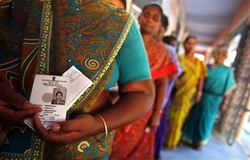 It is 24th April today, and I'm standing from the fourth floor balcony of my flat in Chennai, watching the line form on the street below. I have two polling stations next door - one a corporation primary school and another a Women's social club. The trickle of keen early voters that I saw as I was returning from my run this morning has increased steadily. Unfortunately, my application to be included in the voter rolls was lost in the "system" and I'm going to have to sit this one out. My parents, who live with me, fortunately got in. So as I returned from my run this morning, while I was performing my post-run stretches to cool down, I struck up a conversation with the security guard in the building, Rajappan. He is registered to vote in his village, which is near Thanjavur. I asked him about how he chose his candidate between the various choices available. "Our thalaivar (leader) chooses for us," he said. "He tells us who to vote for and we do it." I had known that this is the way voting happens in our villages; my previous live-in cook, Mallika, had returned to her village in the previous election to make sure she voted according to the wishes of her leader. "If I don't show up and vote, he will not help me if I need it," she explained. We may have a secret ballot, but I suspect people like Rajappan and Mallika believe that their all-powerful Thalaivar knows how they've voted. "Who is your Thalaivar supporting this time?" I asked Rajappan. "DMK," he said nonchalantly. Lofty notions of people like himself taking power into their own hands every five years and holding those they put into power accountable for their deeds and misdeeds while in office were obviously lost on him. The election was just another ritual by which he reaffirmed his loyalty to his Thalaivar who is the only person he could go to for help if he had a problem. And that was the only power that mattered. 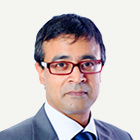 In a Hindu Op-Ed today, Praveen Swami comments on Narendra Modi's explicit statement that he would authorize the use of covert force against our enemies across the border (Dawood, Jihadists in Pakistan and Afghanistan, et al). Swami takes a dovish view of Mr. Modi's statement - he believes that India should not retaliate with covert action because of the fear of retaliation.
In my opinion, this view is what has emboldened our enemies over the past 60 years of our independence. We have to moderate our policies in keeping with the neighbors and adversaries we have. The Israelis retaliated with overwhelming force whenever they were attacked, and that is the way the Arabs surrounding them stopped troubling them or sheltering terrorists who used their soil to launch attacks. These high-fangled Western liberal notions of not using force will work very well in a geo-political environment that respects it. Unfortunately, we have a neighbor that constantly provides aid and succor to forces against us, and we have done little other than complain like a little whining child. This has emboldened the ISI, The Pakistani Army, and even democratically elected governments there to conclude that India will never take action. With impunity they incite, recruit, train and then send terrorists over the border. Pakistan Occupied Kashmir is home to many terrorists training camps where jihadists are brainwashed, trained, and then infiltrated across the border. Like the Arab countries ringing Israel, Pakistan understands only the language of force. If we do not retaliate with force, they will continue to view us as as a weak, spineless debating society, and continue to take potshots at us. We must launch targeted covert strikes, take out leaders of any organizations that are inimical to us, and even launch missile strikes against terrorist training camps in Kashmir. Only then will we put some fear into them, and get them to stop. Even if that means there's a risk of retaliation, we must be prepared to run that risk, and raise our internal vigilance. "Speak softly but carry a big stick," said US president Teddy Roosevelt. All we've been doing is speaking loudly, and never showing our stick. In the nuclear-armed subcontinent we now live in, open all-out war is almost an impossibility. Therefore, low-intensity, localized conflict done using non-state proxies will be the way Pakistan will mount a war of attrition. If we don't stop them by retaliating with force, we will be the only losers.  It is 24th April today, and I'm standing from the fourth floor balcony of my flat in Chennai, watching the line form on the street below. I have two polling stations next door - one a corporation primary school and another a Women's social club. The trickle of keen early voters that I saw as I was returning from my run this morning has increased steadily. Unfortunately, my application to be included in the voter rolls was lost in the "system" and I'm going to have to sit this one out. My parents, who live with me, fortunately got in.
My father, who served in the Air Force for 39 years, rarely got an opportunity to exercise his franchise in the traditional way (going to a polling booth). Every election, I remember a bright yellow envelope that would come to him with his postal ballot - the constituency he would vote in was the place listed as his "permanent residence" in the Air Force records - his sister's home in Tuticorin, Tamil Nadu. One never knows if those postal ballots reached in time, were counted, or were just lost. Member of Parliament Rajeev Chandrashekar, son of one of my father's old Air Force friends, launched a successful campaign to give members of the Armed Forces the right to vote in the place where they are posted, as long as they are not in a field location. Kudos to him for taking up this cause and securing the rights of those who work hardest to protect our democracy. Unfortunately, another class of people who work as hard, and perhaps in less comfortable circumstances, are members of our Para-military forces. During elections, they are rushed from place to place to ensure safe voting for everybody, but they don't have the right to either send an absentee ballot or vote where they are. This is a real travesty and should be addressed soon. Rajeev's work is a good first step, and I hope he takes up the case of members of the CRPF, CISF, BSF and other paramilitary forces soon.  "Don't twist facts to fit your theories; when the facts do not support a theory, throw it out," said Sherlock Holmes to Dr. Watson, a number of times (or something to that effect, anyway). Oh, how could I resist not writing about the MH370 disappearance, given it's link to the themes of The Anza Deception and to, The Sympathy Wave.
I think by now most facts point to either of two possibilities - a deliberate act, or an onboard malfunction that moved so quickly that both pilots could not react quickly enough to save the aircraft. The malfunction theories point to the possibility of an onboard fire, which started somewhere in the electrical circuits that control the aircraft's communication systems - ACARS (Aircraft Communications Addressing and Reporting System), then spread to the transponder and radios, before engulfing the pilots. They could have detected the fire, and tried to turn the aircraft towards a diversion airport (Langkawi is a possible target) but were overcome by fumes and perished. Under this theory, the aircraft should have crashed somewhere on a straight line between the point it turned and Langkawi. The distance depends on when the fire consumer the autopilot, and when the aircraft ran out of fuel. Boeing 777 aircraft are extremely stable - even with the autopilot disabled, the aircraft could have flown for hours before crashing. The other theory, that one or both pilots deliberately diverted the aircraft somewhere, is also supported by some datapoints. The best theory I've seen so far is from Capt. A Ranganathan, an experienced airline captain and contributor to The Hindu. Capt. Ranganathan has a coherent explanation for the various altitude changes made by the plane, and believes that it may be hidden somewhere to be used soon in a terrorist attack, a la 9/11. Chilling thought. You can read his article here. The search is currently being conducted in one of the most remote parts of the planet, off the coast of Australia. It remains to be seen whether the searchers find anything, and till then, we'll keep debating these two theories vigorously. By now, pundits around the country have done a fairly thorough analysis (given available information) of the mishap that struck INS Sindhuratna and resulted in the death of two brave young Navy officers in Mumbai.
However, the bigger question is of the underlying causes that resulted in the Navy being forced to operate the submarine beyond its original decommissioning date, 2013. This appears to have been because of delays in procuring replacements to the Fleet of Kilo-class submarines. Does this story sound familiar? To me it definitely does. Many young fighter pilots have lost their lives because of delays in procuring parts and upgrades to our MiG 21 fleet. They have also suffered because we took long to procure an advanced jet trainer that could replace the Kiran Mk II and ease a pilot's transition from a piston trainer to the Mach-2 performance of the MiG 21. Delays continue to plague our procurement of the MMRCA, which is supposed to be the backbone of our Air Force for the next few decades. Lastly, DRDO has to take a large share of the blame. By making big and bold promises to ill informed politicians and bureaucrats in Delhi, and playing both the political game and the nationalist card to the hilt, they have delayed or deferred the procurement of foreign matériel but at the same time failed to deliver. The Air Force has stopped waiting for it's squadrons of LCA aircraft, and the grand project is likely to go the way of the HF24 Marut, which never made much of an impact on our force levels or capabilities. George Fernandes, when he was Defence Minister, famously posted a few Babus to Siachen to show them the effects of their delays in procuring winter equipment for the soldiers fighting under those challenging conditions. Will AK Antony do the same? A stint in the battery room of a submarine for a few months will surely be an eye opener for the paper pushers in the MoD. |
About meExecutive, entrepreneur, investor and mentor to social entrepreneurs, golf and squash addict, author of thrillers... In short, an amateur dabbler in new experiences, and provoker of thoughts. Archives
June 2026
Categories
All
|
 RSS Feed
Photo from SG2012
